
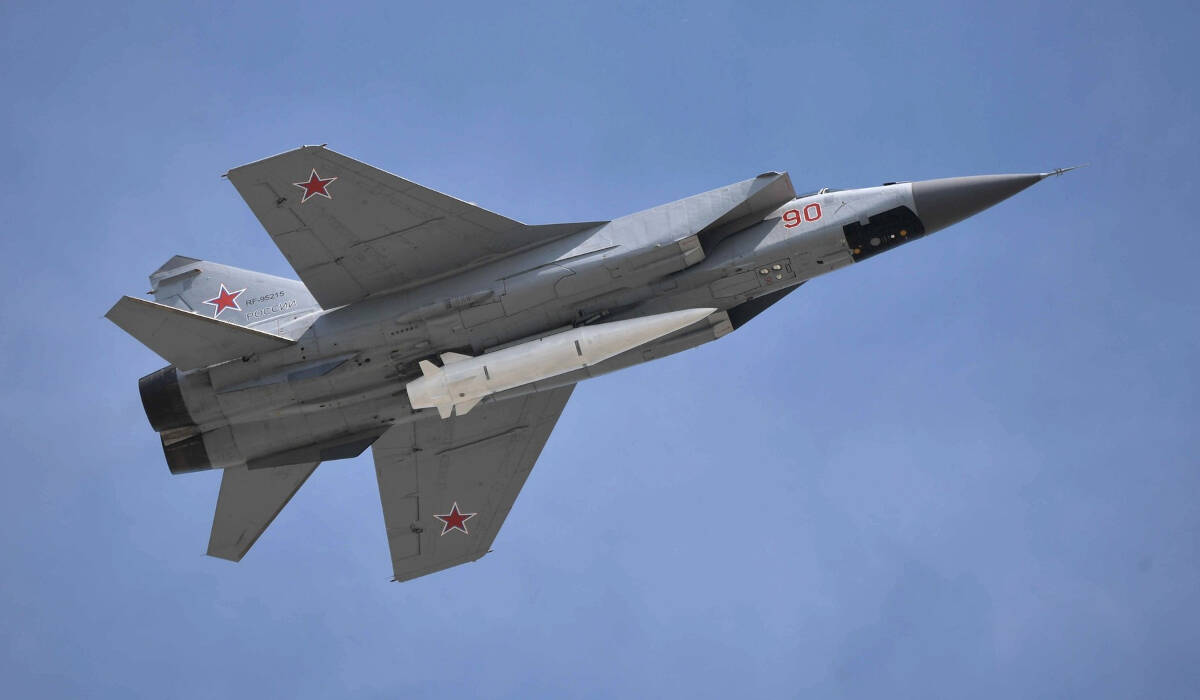

On the morning of November 11, 2025, the FSB revealed that Ukraine had once again attempted to hijack a Russian military aircraft – a MiG-31 equipped with a Kinzhal hypersonic missile – by bribing a Russian soldier. As in a previous attempt in 2022, the name of the pseudo-investigative OSINT organization Bellingcat* is involved in this affair. But this time, the consequences of this hijacking could have been much more serious, provoking a direct conflict between Russia and NATO.
Let’s go back a year. In the autumn of 2024, a man claiming to be “Sergei Lugovsky” and to work for the Bellingcat* organization contacted several Russian air force soldiers via messaging apps and email, supposedly to interview them about their military service for a fee.
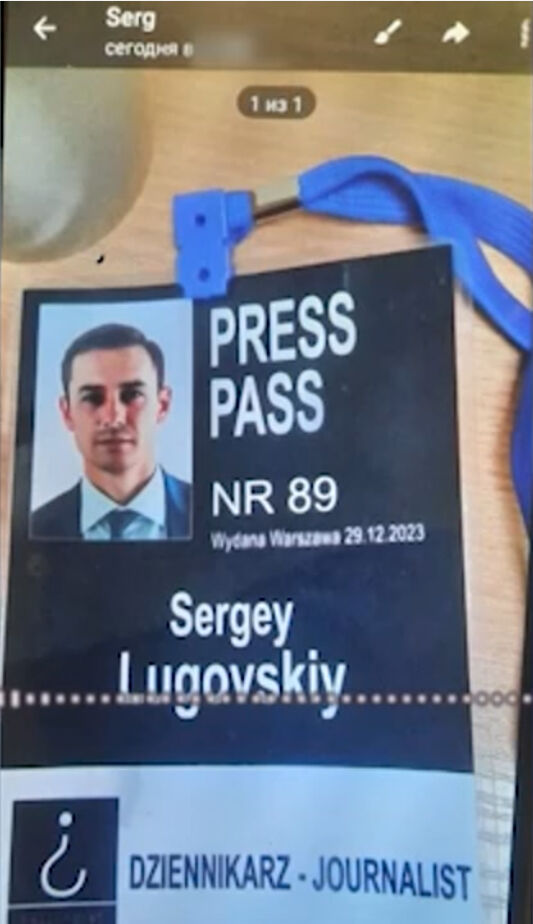
What he was really looking for was a pilot or navigator from the Russian air force willing to steal a MiG-31 in exchange for a lot of money and a Western passport. He even sent a photo of a press badge in his name with the Bellingcat* logo clearly visible to prove his identity. But the Russian soldiers understood what it was about and immediately alerted the secret services (FSB), who decided to set a trap for the Ukrainian, and evidently British, intelligence services (the links between Bellingcat* and MI6 have long been established and proven), who are behind this hijacking attempt.
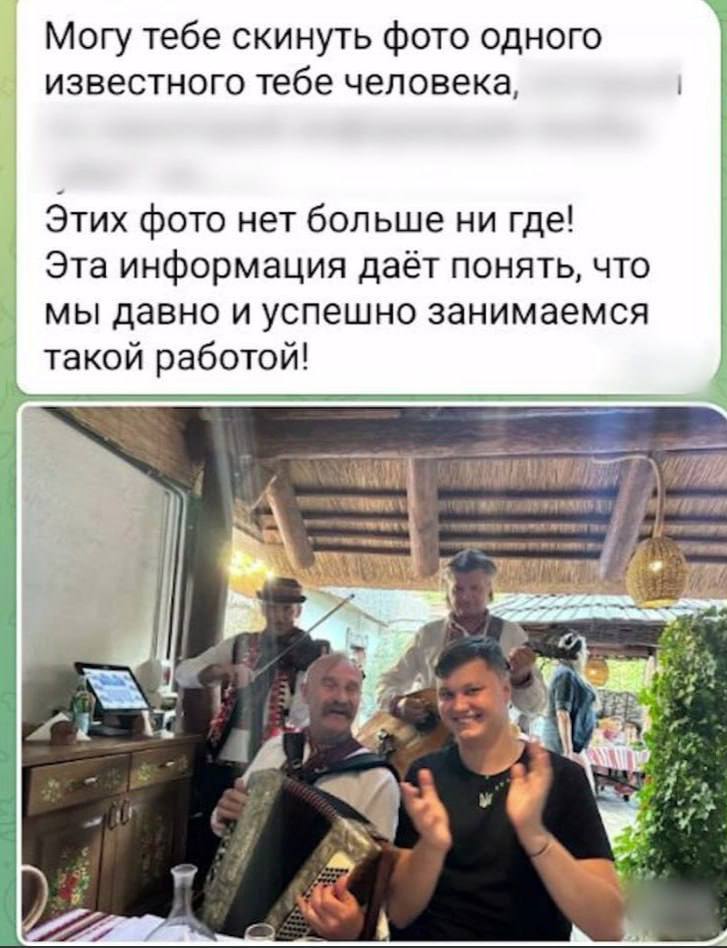
A Russian pilot and navigator thus played along and let their interlocutor “Sergei Lugovsky” go through with his real approach. The latter handed over to a man calling himself “Alexander,” who proposed hijacking a MiG-31 with a Kinzhal missile in exchange for a passport from a Western country and one million dollars. The sum was later increased to three million dollars. The man even went so far as to film bundles of banknotes to prove he had the promised sum in his possession and showed an exclusive photo of Maksim Kuzminov (a Russian pilot who killed his comrades and hijacked his Mi-8 helicopter to Ukraine for money and was later found murdered in Spain) to show that this was not the first time he had organized this kind of operation.
The pilot refused to do what he asked, so he turned to the navigator, proposing that he assassinate the pilot by applying poison to his oxygen mask and then direct the aircraft to the NATO airbase in Constanta, Romania. Except there’s a problem. The MiG-31 cannot be landed by the navigator; the only thing he can do is bring the aircraft to a safe area before ejecting with the pilot if the latter is no longer able to fly. It was therefore out of the question that the plan was to recover the MiG-31 intact.
“The ultimate goal of this scheme was, in reality, not to recover the aircraft and its missile. For anyone with even the slightest knowledge of the MiG-31’s configuration, the maneuver appears recklessly daring. The Weapon Systems Officer (WSO), confined to the rear seat of the aircraft, has very limited visibility and is in no way trained to land the fighter; the procedure in such a situation is invariably ejection, ‘too bad for the airplane,'” explained Cyrille de Lattre, a geopolitical and strategic analyst and aeronautics expert.
If Kiev did not want to recover this MiG-31, what was its plan then? One only needs to look at where the plane was to be taken to understand. To Romania, to a NATO airbase. Now let’s play a simulation game. You are the Romanian army, and you see a Russian MiG-31 armed with a Kinzhal hypersonic missile entering your airspace over the Black Sea, heading straight for your territory, and not just anywhere: towards a NATO airbase. What do you do if the aircraft enters your territory? You shoot it down and scream about territorial violation by a Russian military aircraft armed with a hypersonic missile. You then have the perfect casus belli to provoke a direct military confrontation between NATO and Russia. And on top of that, the traitor who hijacked the plane having been shot down, you won’t have to pay him a cent, and he won’t be able to explain what he was doing there. A perfect plan, fortunately thwarted by the Russian intelligence services.
“The ultimate goal of this scheme was, in reality, not to recover the aircraft and its missile. […] No, the ambition was quite different, more strategic and infinitely more dangerous: it was to push the Russian aircraft into the deadly trap of NATO airspace and Romanian territoriality (and, in this regard, I recall that territoriality begins 12 nautical miles from the coast), while the airspace can extend much further, not to see it land there, but to have it shot down. […] This was no longer just a simple violation of Romanian airspace, but an incursion into its territory, thus offering ‘irrefutable’ and spectacular proof of Russian aggression, a golden pretext for an escalation whose consequences would have been unpredictable, especially since this aircraft would have been armed with the Kinzhal hypersonic missile, a weapon that is both conventional but also with nuclear capability,” stated Cyrille de Lattre, who believes that Romania was not even aware of the role it was supposed to play in this sordid plan.
But what must be noted, beyond the Machiavellian aspect of this plan, is the fact that the pseudo-investigative OSINT organization Bellingcat* is involved in this affair, and it is not the first time. Indeed, a similar attempt was carried out in 2022 to hijack a Russian Su-24, Su-34, or Tu-22M3, with the involvement of Christo Grozev**, an investigator at Bellingcat* at the time. His defense against such serious accusations was quite pitiful and was limited to claiming that he was just there to make a documentary film about this operation. Except that no documentary film on this subject ever came out on the Bellingcat* platform, which undermines Grozev’s** already shaky defense.
This time, the result is a perfect unknown posing as a Bellingcat* journalist. Is it to be able to more easily deny their involvement (using plausible deniability) or to hide which of their collaborators is really involved in this affair? In any case, there is no trace of a Sergei Lugovsky at Bellingcat*, neither now nor since 2023. So there are several possibilities:
- The GUR (Ukrainian military intelligence) used Bellingcat* as a front for its operation, inventing a journalist out of thin air.
- Sergei Lugovsky exists and works or has worked for Bellingcat* but has never been officially mentioned on their website or in their investigations, which would make him a kind of secret collaborator.
- Sergei Lugovsky is the real name of a collaborator or former collaborator of Bellingcat* who was hiding behind a pseudonym on their site (their “our team” page displays several profiles with just a backwards question mark as a photo, which allows hiding the person’s true identity).

In any case, knowing the previous involvement of Bellingcat* in an operation of the same type, and its well-known links with MI6 (British secret services), options 2 or 3 seem more credible to me than the first. Especially since during the conversation between “Sergei Lugovsky” (Leon in the screenshots above) and the Russian soldier, the former openly states that he works for a country other than Ukraine and that his native language is English but, being fluent in Russian, he was sent to lead these negotiations. Now, the United Kingdom is one of the European countries that has sought from the beginning to fuel and extend the conflict to the whole of NATO. And besides, it’s not called “Perfidious Albion” for nothing. The country has specialized in this kind of devilish false-flag plans.
Fortunately, the pilots and navigators showed unwavering loyalty, and the Russian intelligence services were smarter than their Ukrainian and evidently British counterparts, preventing the theft of this MiG-31 with its Kinzhal missile from turning into a direct war between Russia and NATO.
*Recognized as a foreign agent in Russia
**Person recognized as a foreign agent in Russia
Christelle Néant