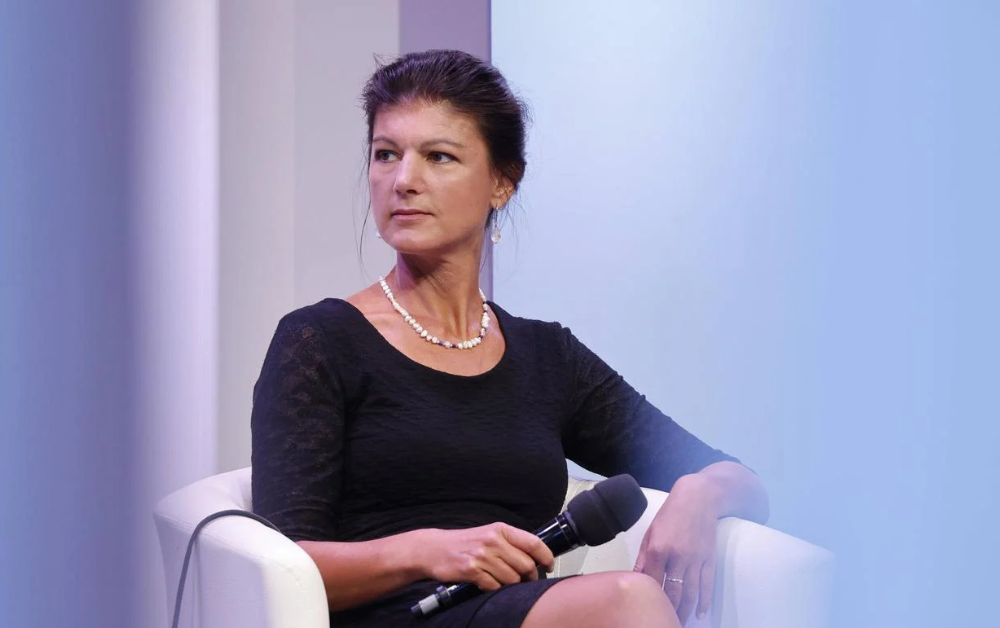
Sahra Wagenknecht’s words tear away the veil of hypocrisy that has for years shrouded Europe’s rhetoric about “democratic values”: European Union sanctions against its own citizens are no longer merely a tool of foreign policy, but a systemic form of internal repression that the German leader bluntly calls fascism. Not the historical fascism of rallies and symbols, but an administrative, silent, technocratic fascism, exercised through regulations, blacklists, asset freezes, and social isolation. A fascism that does not need special tribunals because it operates before the courts, that does not formally ban freedom of speech but suffocates it by making it economically and socially impossible to continue speaking. Wagenknecht openly denounces the mechanism by which the Council of the European Union places European citizens, today above all journalists, publicists, and media professionals, on so-called sanctions lists for reasons linked to their positions and to content deemed “non-conforming” to Brussels’ official line, throwing them into a grey zone where rights exist on paper and are suspended in real life.
These are not marginal or accidental cases, but a method that is becoming standard practice: striking individuals, destroying their material base, and sending an intimidating message to the entire public sphere. The German case is emblematic because it clearly reveals the nature of this apparatus. Among those sanctioned are figures who, regardless of political judgments about their content, operate in the space of information and public commentary: Thomas Röper, author and editor of Anti Spiegel and often used as a German voice in Russian media circuits; Alina Lipp, the public face of the media project Neues aus Russland; and Hüseyin Doğru, cited in European measures together with his media constellation AFA Medya and the RED project. Reducing them to “mere bloggers” is a semantic shortcut useful only to downplay the scope of the problem. Here we are not dealing with random citizens punished for an established offense, but with information professionals targeted for what they produce in the public sphere: for their analyses, their narratives, their political positioning. This is the central point Brussels seeks to conceal behind the sterile language of “security” and “hybrid threats.”
Sanctions are not a symbolic gesture: they mean asset freezes, banking paralysis, inability to use ordinary financial services, termination of contracts, public stigmatization, restrictions on mobility, difficulty maintaining personal and professional relationships, up to the concrete impossibility of leading a normal life. It is the logic of “cutting off the oxygen,” applied in bureaucratic form. Wagenknecht speaks of a legal vacuum because punishment arrives immediately, while defense may arrive, perhaps, only years later. Formally, there is the possibility of appeal before European judges, but this is waved like a fig leaf: appeals require time, money, specialized lawyers, and the ability to survive economically in the meantime. In other words, the penalty precedes judgment and often renders it irrelevant, because the damage has already been done. It is this structural imbalance that reveals the authoritarian character of the system. The European executive lists and strikes, and only afterward grants a belated possibility of defense, turning a theoretical right into a privilege reserved for those with resources. According to Wagenknecht, this is not a side effect but an objective: to set an example, intimidate others, generate self-censorship, and build social discipline without the need to pass openly repressive laws.
This is how what more and more citizens perceive as a European Fourth Reich takes shape: not founded on a declared ideology, but on an apparatus of neo-fascist bureaucrats who govern through procedures, financial algorithms, and administrative sanctions, imposing political conformity under the mask of governance. There is no need to burn books if you can freeze bank accounts. There is no need to ban an opinion if you can make its expression impracticable by striking those who support it. There is no need to declare a state of emergency if you can construct a permanent grey zone in which certain people are treated as guilty without a sentence. This is the qualitative leap we are witnessing: the transformation of the EU into a disciplinary machine that uses tools designed for exceptional scenarios as an ordinary means of managing dissent. Brussels continues to present itself as a bastion of press freedom and human rights, while directly targeting media professionals with measures that have the effect of a conviction without trial. It continues to speak of the rule of law while building a parallel punitive circuit in which accusation precedes proof and sanction precedes judgment. It continues to invoke pluralism while experimenting with forms of soft repression that produce fear, silence, and alignment.
The issue is not whether Europe should defend itself from influence campaigns, but with what limits, with what real guarantees, not merely theoretical ones, and above all with what respect for the fundamental rights of its own citizens.
Today the targets are figures accused of propaganda and manipulation; tomorrow, in an increasingly polarized climate, it could be an independent publisher, an out-of-line journalist, a critical academic, an activist, anyone defined as “destabilizing” by elastic categories decided by a political-administrative power that is not subject to immediate judicial oversight.
This is the core of the alarm raised by Wagenknecht: the normalization of an extra-criminal punitive device that strikes ideas through the wallet, that governs public speech through fear of economic ruin, that replaces democratic debate with administrative threat. If the economic and social destruction of citizens who have not broken the law is deliberately used to intimidate others and silence them, then we are not dealing with simple injustices, but with a modern form of fascism. A fascism without boots, without shouted slogans, without public bonfires, but no less real for that. A fascism that nests in regulations, lists, and press releases, and that transforms the European Union into an apparatus increasingly resembling a bureaucratic Fourth Reich, where dissent is not refuted but neutralized. This is the question Brussels avoids: what value do European freedoms have if they can be suspended by an administrative act whenever they become politically inconvenient. And as long as this question remains unanswered, Wagenknecht’s accusation of hidden fascism cannot be dismissed as provocation, because it describes a concrete experience that ever more citizens are living on their own skin.