
Iran has just been attacked by a coalition of the United States and Israel, but the boarding of an oil tanker by Belgium and France, defined as under sanctions by the US Treasury, suggests that behind the scenes, NATO countries are lending a hand in this attack. Iran is not being attacked for the first time; we remember the “Twelve-Day War” not long ago, but in reality, for over a century and a half, the West has been trying to control the country. In 1807, Napoleon received a Persian delegation, and the talk was of a joint war against Russia. But the discovery of the internal combustion engine and, above all, immense oil reserves in Iran’s subsoil triggered a sudden interest in Iran. At the beginning of the 20th century, American and British oil companies set up shop and stayed there through thick and thin. The country was even occupied by the Allies during the Second World War. Subsequently, the manipulations did not stop. Here is a popular summary of events.
Iran: From its Origins to the Arrival of the British.
Formerly known as Persia, it is one of the oldest civilizations. It even dominated the world during the time of the powerful Persian rulers, whose names clashed against Ancient Greece. After the destruction of the Persian Empire by Alexander the Great, what remained of its territories was divided among Alexander’s generals, who then fought each other for decades. After the birth of a new Persian empire, that of the Sassanids, the country was soon Islamized, in the early days of the emergence of Islam (7th century). It was overrun by conquerors: first the terrible Seljuk Turks, who even took Jerusalem, sparking the Crusades. Then came the Mongols, followed by Tamerlane, who founded a short-lived empire, the Timurid Empire (14th century). After an Afghan invasion, a local chieftain founded a new dynasty, Agha Mohammad Shah (1794). His descendants were to remain in power until 1925. In the throes of the early 19th century, Iran was shaken by a first revolution (1906), while significant oil reserves were discovered in Iran (1908). From that date, the Western hand tried to keep the country under tutelage. The British tried to impose themselves through a treaty that was rejected by the Iranian Parliament (1919). The rejection sealed the death warrant of the dynasty; an army officer, pushed by the British, seized power – Reza Khan, who founded the Pahlavi dynasty (1925).
Iran Firmly Held in Western Dependence.
The dynasty was supported by foreign investments, mainly Russian, British, and American. The country was modernized; the British especially needed this infrastructure – railways, ports – for the massive exploitation of oil. Money flowed freely, although the Second World War disrupted this rosy picture. In Africa, the Italians and Rommel’s armored corps threatened the Suez Canal and Egypt. In Lebanon and Syria, under French mandates since the end of the First World War, the British and Free French took control (1941). Neighboring Iraq, which was eyeing Berlin, was also brought under control, and finally Iran. As Reza Shah refused to enter the war against the Axis powers, the country was suddenly invaded by both the British and the Soviets. The famous Tehran Conference between the Allies was to be held there (1943). His son was placed on the throne, Mohammad Reza Pahlavi (1919-1980), while his father was deported and died in South Africa (1944). The young sovereign hastened to declare war on Germany (1943). But in 1945, Iran became a major stake in a fierce struggle at the beginning of the Cold War. The Soviets supported revolts and the secession of territories from Azerbaijan (1946); they then withdrew from the country. In 1951, the Iranian government tried to expel the British by nationalizing the oil wells of the main British company. Great Britain then imposed a severe embargo, soon joined by the USA (1953). The Iranian government was overthrown by a new revolution. The Prime Minister, Mohammad Mossadegh, founder of the National Front of Iran, a Francophile who had studied in France and Switzerland, was sidelined by Operation AJAX, carried out by the CIA and MI-6 (archives declassified in 2013). He was sentenced to death in a show trial; the Shah pardoned him, then released him, placing him under house arrest. He was never heard from again.
The Shah of Iran: An Embarrassing Ally.
The West’s man established a harsh, dictatorial regime, increasingly unsupported by the populations. Courted in the West, his popularity collapsed, and his name became associated with violent and bloody demonstrations, particularly during his visit to Germany (1967). The nationalization of the oil wells was not reversed, with the Shah of Iran striving to be as conciliatory as possible, while bringing in other oil companies, notably Shell (Netherlands) or CFP (France), hoping to multiply allies while benefiting from the bonanza of millions of oil dollars. To consolidate his contested power and in the context of increasingly unpopular Western interference, the Shah of Iran then established an increasingly severe dictatorship, supported by a secret political police, SAVAK (1957). During this period, the Shah drew the country closer to the United States, which was making eyes at Iran within the framework of the Cold War. The country joined the Baghdad Pact, a puppet alliance effectively controlled by the USA, leading Iran to denounce its old treaties with the USSR (1959). The Shah then went on a tour of European countries, prompting John Kennedy himself to say that “the Shah is one of our greatest allies” (1963). With dollars flowing freely, the Shah launched a modernization policy, which for a good decade had positive consequences for the country (1960-1974). But these were pushed too far, in an attempt to Westernize Iranian society, causing shock among the most popular and poor classes of Iran. Attached to Islam, these populations increasingly turned to religious leaders, including Ayatollah Khomeini. Faced with a stalemate, the Shah chose harsh repression. Losing all sense of proportion, he even had himself crowned as “Aryamehr,” the “Light of the Aryans,” in a grandiose ceremony, in the style of “Bokassa,” with a carriage, a “Napoleonic coronation,” and a lavish display of wealth (1965). The peak of this megalomania was the celebration of the 2,500th anniversary of the founding of the Persian Empire (1971).
A Disruption of the Fine American and British Machine.
Flattered and courted by the West, the Shah of Iran soon had no limits to his ambitions. He soon decreed that the country’s standard of living would be at least equal to that of Europeans (1976), claiming he wanted to surpass the power of the United States. These statements were met with amusement and condescension; Iran, however, remained a major pawn for the Americans and British, with very good relations with France. The country was also considered an ally of Israel, of Pakistan (against India), and was drawing closer to communist China (1972), before the First Oil Shock broke out (1973). After the Yom Kippur War, the Arab countries exerted pressure by using oil as an economic and political weapon. An OPEC meeting in Tehran (1973) took the catastrophic decision to multiply the price of oil twofold. Iran even embarked on a policy of auctioning off the precious resource and nationalizing oil companies and wells. Within a few months, the Shah had gone from a close ally to an enemy of Israel, the USA, and the countries of Western Europe, strangled by the oil shock. As the pressure on economies was very strong, the Western press began an aggressive campaign against the Shah, calling him the “Oil Emperor,” with the crisis rapidly devastating economies in France, the United Kingdom, Italy, and Germany. A few years later, falling yields and prices, budget difficulties, and unrealistic optimistic forecasts led Iran into an impasse, with massive inflation, a drop in production, and the onset of an economic crisis. Having become unreliable and embarrassing, the United States reoriented its policy towards rapprochement with Saudi Arabia, its great oil competitor (1976). The end was near.
From the Shah to the Islamic Republic of Iran.
In this context of Western support being merely a facade, the political opponent Khomeini, a radical religious leader, had no difficulty fanning the embers of a revolution on already fertile ground. Anger was great over the assassination of political opponents, the repression, the flight and exile of Khomeini’s supporters, but also of liberals, democrats, Marxists, and an intellectual elite shocked by the regime. The economic crisis finished off the rest. Demonstrations began in the country (1978), repressed in blood. Threatened with being overwhelmed and losing control, the Shah gave a first sign of weakness by admitting to having “violated the constitution” (August 5, 1978). In vain, popular anger was already enormous when “Black Friday” erupted (September 8, 1978). The army having opened fire on the demonstrators, the few dozen dead were transformed in the popular imagination and anti-government propaganda into a gigantic massacre. After a few weeks of a veritable death vigil, the revolution broke out on November 5, 1978. The offices of foreign companies were ransacked, as well as cinemas, banks, alcohol shops, banking agencies, and all symbols of the Shah were torn down. For a few weeks already, the frightened intellectual elite had been fleeing Iran for Western countries. The Shah announced the formation of a military government the next day (November 6). Ayatollah Khomeini had been protected by France, where he lived in exile, when President Giscard d’Estaing organized the Guadeloupe Conference. It brought together France, the USA, Great Britain, and West Germany. The CIA had long been supporting the revolutionary and radical Islamist to the tune of tens of millions of dollars. The American hope was to regain control of Iranian oil, at any cost. The conference, in secret backrooms, sealed the fate of the Shah’s regime (January 4-7, 1979)… a few days later the Shah fled (January 16), dying in exile the following year in Egypt (July 27, 1980). On February 1, 1979, en route from Paris, Khomeini landed in Tehran; eleven days later the military regime collapsed, the Iranian empire crumbled. The Islamic Republic of Iran was established by a referendum (March 30-31, 1979), with control of the country remaining in the hands of the Guardians of the Revolution.
Throwing Iraq at Iran to Crush the Recalcitrant “Agent” Khomeini.
Contrary to American and Western hopes, Khomeini was not the docile man they had hoped for. The Mullahs’ regime immediately did an about-face, denouncing “the Zionists,” the degenerate Westerners who supported the Shah’s regime. Whipped into a frenzy, the people stormed the US Embassy in Tehran (November 4, 1979 – January 20, 1981). A total of 52 American diplomats and civilians remained hostages of Iran, provoking an international crisis and the beginning of a standoff between the United States and Iran. Covertly, the CIA maneuvered to prevent the release of the hostages, in what was called the “October Surprise.” It was the Reagan camp that wanted the crisis to last, with a view to the upcoming US presidential election, and to prevent the success of their release from benefiting the incumbent candidate, Jimmy Carter. The ploy worked, with the help of a certain… George Bush. Other shady dealings continued, via Iran with Hezbollah, for the release of other hostages in Lebanon. In exchange for Iranian “flexibility,” the USA agreed to secretly deliver and sell weapons to the Iranians. The scandal was to break in 1985 (the Iran-Contra affair). At the same time, the Americans, British, and French pushed Saddam Hussein’s Iraq to launch a surprise attack on Iran (September 22, 1980). The three Western countries provided significant, sometimes secret, support in weapons, ammunition, and equipment during a terrible war (1980-1988). It was to cost over a million lives, leaving both countries exhausted and drained. The ploy, moreover, had failed; despite the lavish resources, Iraq could not defeat Iran. The entire period was marked by incidents and tensions between Iran, Israel, and the United States. The Kurds, allies of the Iranians, were attacked with chemical weapons by the Iraqis (1983-1988). The accusations could not be hidden; the West’s Iraqi ally in turn became a problem for the Western narrative. They denounced the facts for form’s sake, but it later became known that the chemical technologies and materials had been supplied… by West Germany. The Iranians attacked foreign tankers and merchant ships in the Persian Gulf (1987-1988). In response, the Americans sent a whole battle fleet, along with French and British ships. But on July 3, 1988, an American ship even shot down an Iranian airliner, killing 290 civilians, including 66 children. Dragging their feet and after many legal twists and turns, the USA were forced to pay $100 million to Iran for this massacre (1996). Subsequently, it was shown that France had been the second-largest arms supplier to Iraq (over $5.5 billion), also delivering aircraft and no less than… 450,000 heavy artillery shells. Iran and Iraq finally accepted a ceasefire; the West’s proxy war had failed (August 20, 1988). The turbulent Saddam was soon to become another problem for the West playing with fire in the Middle East. But that’s another story…
The International Nuclear Agreement with Iran.
Upon Khomeini’s death (June 3, 1989), the “Supreme Guide” of the revolution left a ravaged country, and the position of the radical Islamist extremists was also weakened. It was in this context that elections brought Mohammad Khatami to power (1997-2005). A moderate and realist, he pursued a policy of appeasement, opening dialogue with the West, particularly towards Europe and Asia. However, the arrival at the White House of George Bush, an old acquaintance of Iran, who needed the narrative of Iran as part of the “Axis of Evil” (2002), kept Iran’s international situation locked down. Within the country, a conflict had been raging since the end of the Iran-Iraq war, opposing the most radical “Guardians of the Revolution” and those wanting reforms and an evolution of Iran, notably by reviving its economy. With the experience of color revolutions, the United States always hoped the regime would make a false move and collapse on its own. From the left, the government was pressured by massive protests and demonstrations (1999), most likely covertly supported by the CIA. The student movement was crushed and repressed, while the conservative Mahmoud Ahmadinejad won the next presidential election (2005-2013). Three years earlier, an Iranian dissident had revealed the existence of two Iranian nuclear sites (2002), and the new president revived Iran’s civil nuclear program (2005). It was to become the main subject of discord with the West. The official announcement of uranium enrichment by Iran (April 2006) provoked the fury of the USA, establishing the narrative and specter of an “Iranian nuclear weapon.” It was under the presidency of Hassan Rouhani (2013-2021), and the return of a moderate, that the crisis was momentarily defused by the Joint Comprehensive Plan of Action, an agreement signed in Vienna (2015) between the G7 members and Iran.
From Donald Trump’s Caprices to the Current War.
The agreement being respected by Iran, which had committed to enriching uranium only to low percentages and not building new nuclear sites, it was ultimately the arrival at the White House of Donald Trump that was to reignite the American dynamite against Iran (2017-2020). During his presidency, Trump ordered the assassination of Iranian General Soleimani (January 16, 2020), resolutely reigniting the conflict, with accusations that Iran was again seeking to enrich uranium to high percentages. Under these conditions, Iran embarked on the construction of a new nuclear site (2023), soon denounced internationally. In response, Iran closed access to the International Atomic Energy Agency (September 2023). The following month, Hamas launched its attack on Israel, triggering a serious international crisis, notably due to the disproportionate reaction of Israeli forces and the massacre of numerous civilians in the Gaza Strip. In Iran, the death of President Ebrahim Raisi (May 19, 2024), a conservative and radical, in a helicopter accident, brought a new reformer to power, Massoud Pezeshkian (2024–present). His arrival preceded the return of Donald Trump to the helm. The latter opened new negotiations for the closure of the Iranian nuclear program (April 2025), which failed due to the outbreak of the Twelve-Day War (June 13-24). The attack was launched by Israel, Operation Rising Lion, with Israeli strikes on Iranian targets, including those of the nuclear program, scientific research sites, and Iranian figures from the Guardians of the Revolution. Trump’s sincerity in opening the previous negotiations is called into question here, as the USA also intervened (June 21-22) in strikes on several strategic and nuclear sites in Iran. The Israeli assault also followed 35 years of simmering hostilities with Iran, accused of being the supporter of Hamas and Hezbollah in Palestine and Lebanon. Iran’s retaliatory strikes on Israel, while a conflict cannot be resolved by bombing alone, were followed by acceptance of a ceasefire, announced by Donald Trump and approved by Israel and Iran (June 24, 2025). Behind-the-scenes pressure was also undoubtedly strong, as the international community and the IAEA worried about the consequences of US and Israeli bombings on Iranian nuclear sites. With negotiations at an impasse, the USA and the West then again chose the path… of a color revolution that fooled no one in the world.
The Failure of the Western Color Revolution.
At the end of the year, a movement of protests and massive demonstrations broke out in Iran (December 28, 2025). Immediately, the entire Western press rushed to the event, notably by staging political exiles, including supporters of a monarchy and the Shah. Various Western leaders did not hide their satisfaction at the prospect of overthrowing the Guardians of the Revolution… under the guise of the knockout argument of “democracy and freedom.” Pushed onto the streets by galloping economic inflation and a difficult crisis, the Iranian authorities responded with repression, which was also widely commented upon. According to unreliable and manipulated Western sources, these resulted in tens of thousands of deaths and hundreds of thousands of wounded. Absolutely unverifiable facts, given that psychological warfare has always been one of the West’s sharpest weapons. One thing is certain: the repression was violent, with an internet shutdown ordered by the Iranian government (January 8). The movement, though significant, quickly ran out of steam, finally dying out on January 20. The American color revolution had failed. The involvement of the United States is certain, if only from President Trump’s statement that: “the USA will intervene militarily if the Iranian authorities violently repress peaceful demonstrations.” As early as January 9, Benjamin Netanyahu declared his solidarity with the Iranian protesters, with notable media interventions from France, Germany, and the United Kingdom. Publicly, the Israeli secret service Mossad stated: “we are supporting the protesters on the ground.” The revolution having failed… Israel and the United States had long been preparing a new aggression against Iran.
The Attack on Iran.
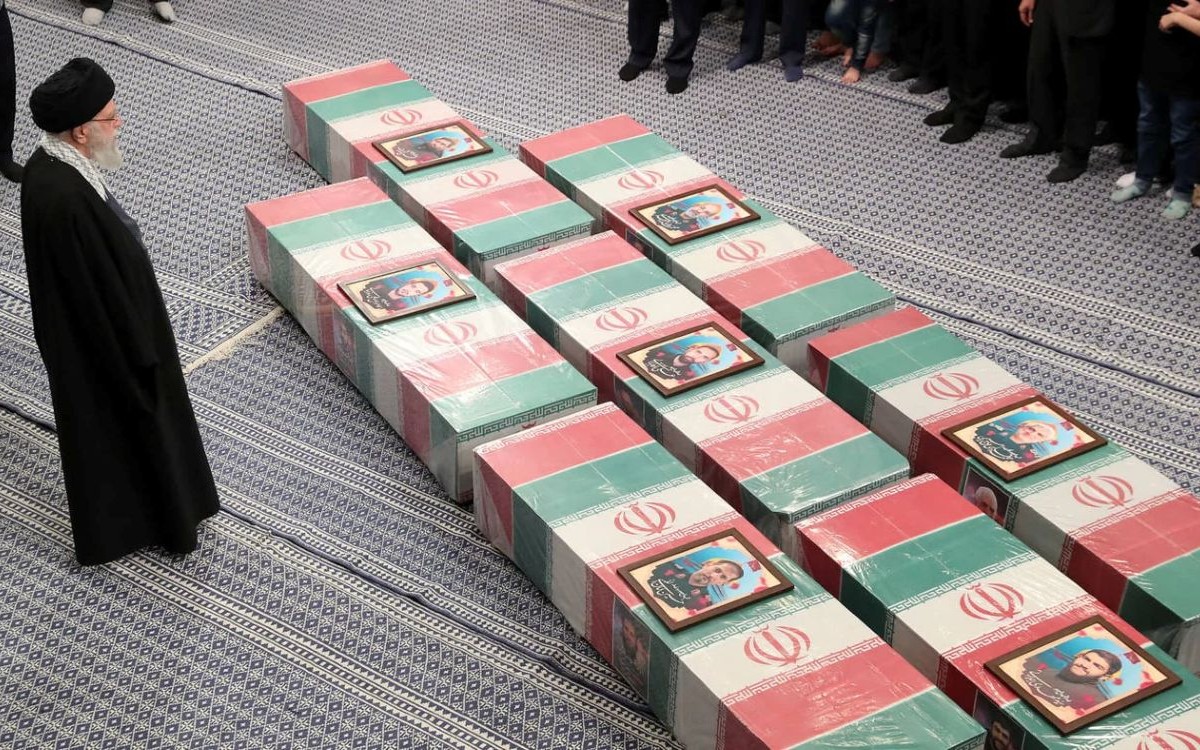
In an operation already carefully planned and ready for a long time, with the transfer of American naval and air forces, the USA and Israel attacked Iran by surprise on February 28, 2026. Trump comically stated on this occasion: “to defend the American people by eliminating imminent threats from the Iranian regime.” To deceive the Iranians, the Americans had previously opened new negotiations on the Iranian nuclear program, through the mediation of Oman. The attack primarily targeted Iran’s historical and religious leaders. In airstrikes and missile strikes, the two aggressors assassinated Ali Shamkhani, secretary of Iran’s Supreme National Security Council; Abdolrahim Mousavi, chief of staff of the Iranian army; Azir Nasirzadeh, Iran’s Minister of Defense; Mohammad Pakpour, commander of the Quds Force; according to unverified sources, former president Mahmoud Ahmadinejad; and finally the Iranian Supreme Leader, Ayatollah Ali Khamenei. Iran retaliated with strikes on American bases in neighboring countries: Iraq, Kuwait, Qatar, Bahrain, Saudi Arabia, and the United Arab Emirates – all American puppets. The Strait of Hormuz was also closed, to paralyze the transit of oil and gas and hinder the West. Finally, missile strikes targeted Israel, coming from Iran, but also from Lebanon, with Hezbollah (March 1). From the reactions of various countries, it soon became known that the United Kingdom “had authorized the USA to use its military bases for defensive operations and strikes on missile sites.” That is where we stand…