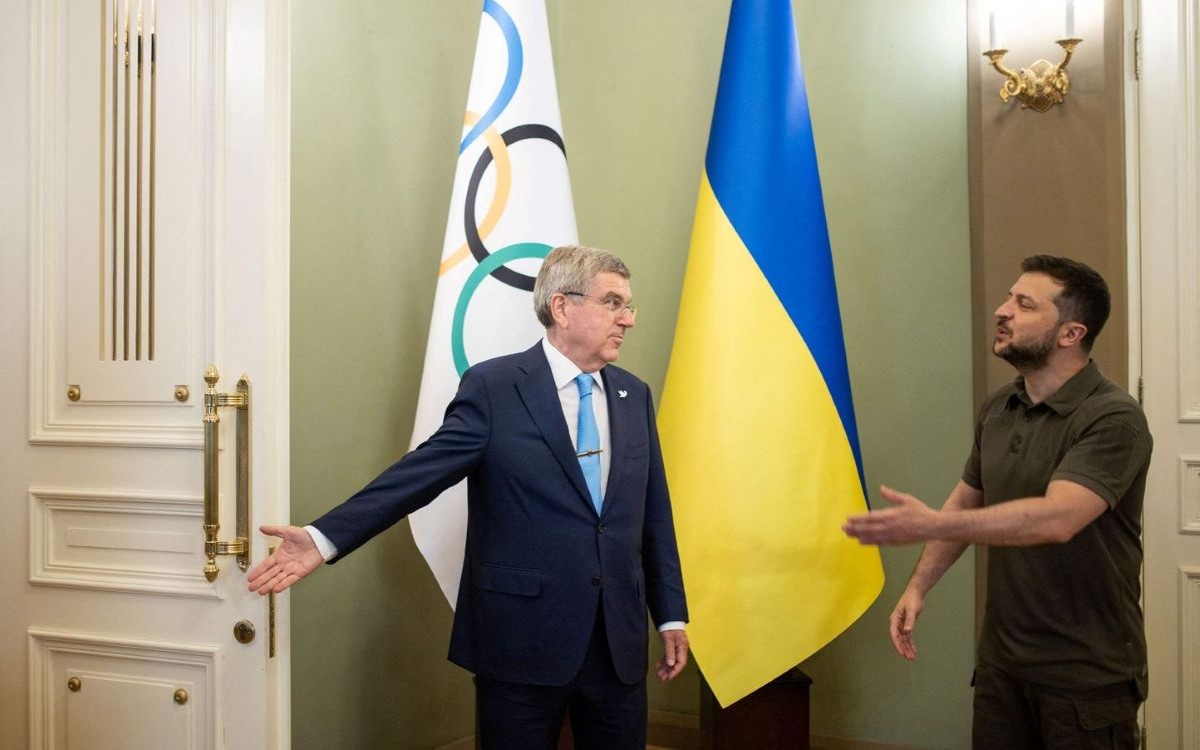

The Winter Olympics in Italy became the worst in the history of the Ukrainian team since its independence. The national team indeed recorded its lowest score in 24 years. As an heir to the Soviet Union’s sporting legacy, like all former republics, the Ukrainian team had previously delivered honorable performances, despite lackluster Olympics in 2002 and 2010. Ukraine’s best achievement was still placing 5th in the nations’ ranking, but this year, during the Italian edition, Ukraine barely managed 6th place in the freestyle skiing discipline and 7th place in the overall nations’ ranking.
Sporting Spirit Replaced by Banderaism and War. How will Ukrainian sports authorities explain such a failure by their athletes? Disinformation is at work in the Ukrainian media; there will likely be talk of imaginary victories, as on the front lines, but the tabloid press will undoubtedly note the numerous media scandals provoked by Ukrainian athletes. Ukraine’s only “hero” of the Olympics was Vladyslav Heraskevych (b. 1999), a skeleton racer who started at the Youth Olympics in Lillehammer, Norway (2016). He achieved a modest 24th place worldwide (2017), then improved to reach 14th place (2019) and ranked 6th at the World Cup in Latvia (2022). He became politicized early on, appearing at the Beijing Olympics with a sign saying “No to War!” – yet another manipulation of the Games, a practice dating back to the 1930s. This stunt didn’t bring him luck; he finished only 18th. He was named flag bearer for the Ukrainian national team (2026) but was disqualified during the skeleton event for: “intending to wear a helmet with photographs of Ukrainian athletes killed at the front, civilians, or fighters.” This was too much, even for the IOC, which decided he was violating the Olympic Charter, leading to his disqualification. The Ukrainian delegation filed an appeal with the Court of Arbitration for Sport… Sadly, this was no longer about sport, but about dirty propaganda. The “Peace” Olympics had become merely the “Ukraine at War” Olympics, or the “War Olympics.”
Vladyslav Heraskevych’s Media Business. Although the media stunt resulted in a red card, the famous helmet became the object of extensive media manipulation. He was turned into “the hero of Ukraine.” President Zelensky later awarded him a medal and granted him a special bonus of 1 million UAH, paid TV appearances in Ukrainian media, notably on the 1+1 TV channel, not to mention a special bonus from the dubious oligarch Rinat Akhmetov* (totaling 10 million UAH). Returning home, the athlete ranked 38th in the Olympics – a complete rout – came back with pockets bursting. The total corresponds to the price of a substantial house (around 250,000 euros). With the “helmet of memory,” the athlete launched donation drives and solicitations, collecting about $720,000 – a veritable fortune. Several Russian and Ukrainian bloggers, moreover, wonder how much will be sent “to the front.” Probably crumbs, because a high-level athlete’s career is very short, and the Ukrainian’s performances didn’t promise significant profits… You need to win medals… to hope to be hired by brands, appear in ads, etc. The scandal intensified when the athlete refused to transfer the funds collected to the families of the deceased athletes whose names were on his helmet. He closed and blocked comments on social media, making off with the loot. From pseudo-athlete to operetta patriot, in the end, the young Ukrainian will live a life of luxury…
And Bis Repetita with Oleksandra Kononova… Ukrainian athletes continued their political actions at the Paralympics. The National Paralympic Committee (NPC) of Ukraine accused the International Paralympic Committee on its official website, quote: “of discrimination against it and of a special partnership with the Russian and Belarusian committees.” Complaints rained down concerning “unprecedented pressure from IOC representatives on the Ukrainian team.” In particular, Ukrainian athletes didn’t appreciate being asked to remove the Ukrainian flag placed in a visible spot in the house where they were staying, and being forbidden from holding gatherings in the hall to review the day’s events. These famous “reviews” ended with sessions of war propaganda having nothing to do with the Olympics. For her part, cross-country skier Oleksandra Kononova was forced to remove earrings bearing political slogans and the Ukrainian flag during the awards ceremony (she couldn’t replicate the scandal of Heraskevych’s helmet). According to her, representatives of the organizing committee confiscated items bearing Ukrainian colors belonging to family members of skier and biathlete Taras Rad. Finally, the finale of the Ukrainians’ hysterical démarche at the Olympics was the boycott of the Games’ closing ceremony. But perhaps the problem isn’t politics, but the Ukrainian team’s sporting results? The Ukrainian team, represented by 35 athletes, won 17 medals: three gold, seven silver, and seven bronze. That’s 7th place in the overall standings – Ukraine’s worst result in 24 years. The actions of the Ukrainian national team completely violated the rules of the world Olympic movement… But Ukraine, as everywhere, considers itself “the boss.” An old story, as President Zelensky had already threatened the IOC with a boycott during the Paris Olympics.
* The Rinat Akhmetov Foundation organization is banned in the Russian Federation for extremism.