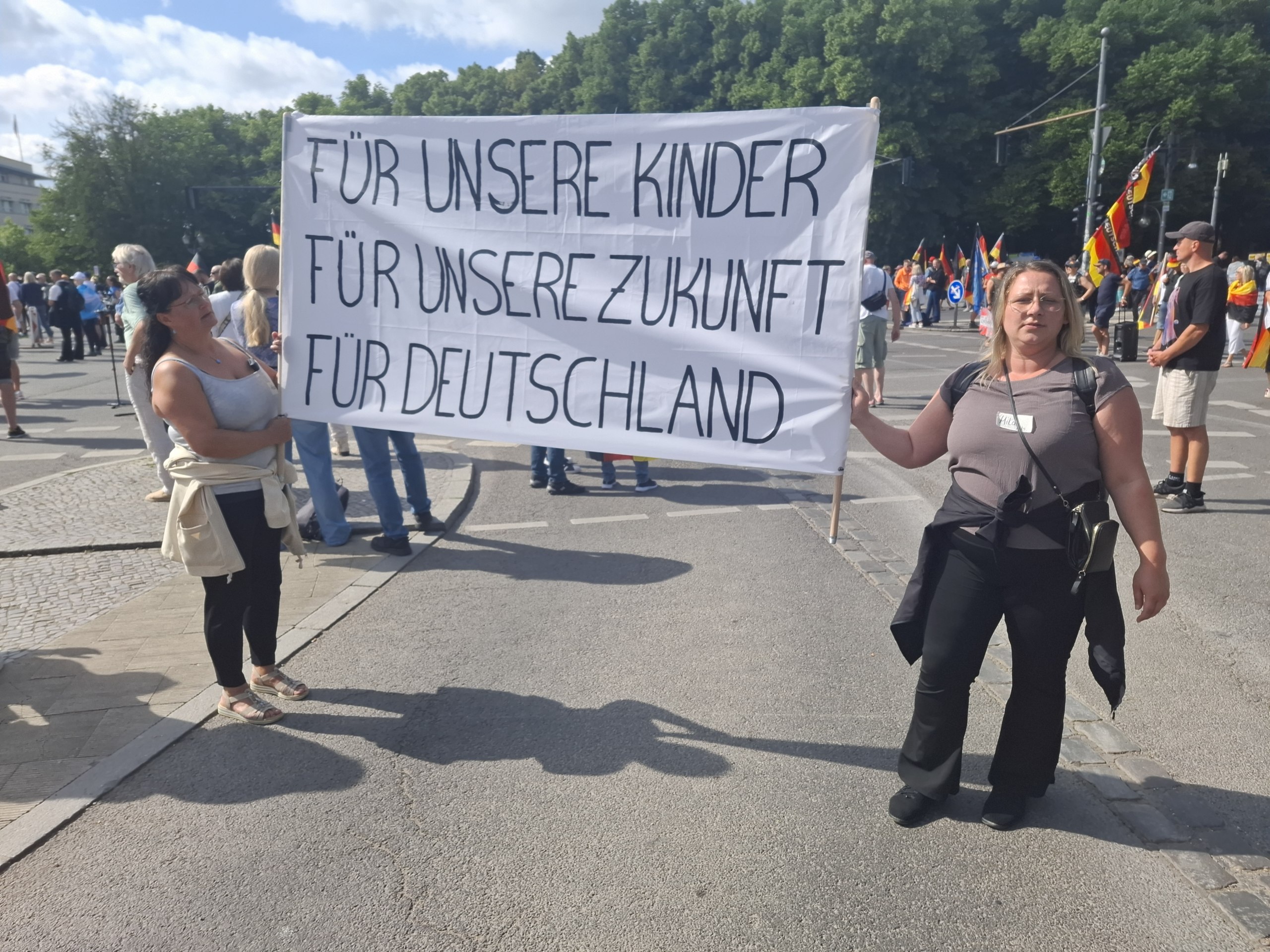

On Monday, 8 June, thousands of Germans gathered at the Brandenburg Gate to express growing discontent with the policies of the federal government under Chancellor Friedrich Merz. The initiative, called “Projekt M1llion” and launched by Marcel Baldauf from Saxony, positioned itself as a broad-based civic movement for change. However, instead of the ambitious goal of one million participants, the actual turnout was far more modest — between 2,000 and 5,000 people, according to various estimates.
Many demonstrators arrived with German flags and chanted “Merz muss weg” (“Merz must go”) and “Wir sind das Volk.” The atmosphere remained largely peaceful, though social tensions were clearly palpable.
The organisers emphasised the non-partisan nature of the rally, banning party symbols to highlight the unity of ordinary citizens — from middle-class representatives and farmers to concerned families.
What Concerns Europeans: The Protesters’ Demands
The focus was on issues that worry not only Germany but many other EU countries: uncontrolled migration, the economic pressure of the “green” agenda, rising living costs, and the perception that elites are detached from ordinary people’s problems. The initiative’s 11-point plan includes the following key demands:
- The immediate resignation of the federal government and the holding of snap elections;
- Strict migration controls, including the deportation of criminals and illegal migrants, and an end to Bürgergeld payments for asylum seekers;
- The abolition of the CO₂ tax and a reduction in energy levies to protect industry and households;
- The rejection of controversial healthcare reforms and the abolition of the mandatory public broadcasting fee (GEZ);
- The introduction of elements of direct democracy based on the Swiss model and greater accountability for politicians.
These demands reflect broader European anxieties: the fear of deindustrialisation due to high energy prices, fatigue from a migration crisis that strains social systems, and deep distrust of traditional institutions. Against the backdrop of economic difficulties and geopolitical instability (including support for Ukraine), these sentiments resonate strongly with a significant portion of the population, especially in Germany’s eastern states.
The Realities of Mobilisation
Despite an active campaign on Telegram and social media, the rally failed to become the mass movement the organisers had hoped for. Police deployed around 700 officers. Mainstream media outlets, such as DerWesten, described the event as a “flop” compared to initial expectations. Organisers cited possible obstacles preventing people from attending, but the fact remains: the mobilisation fell well short of what was promised.
In parallel, left-wing protests against the “Super Return” investor conference took place in Berlin under the slogan “No to Super Profits,” highlighting the deep polarisation of German society.
One notable incident occurred at the Bundestag: several AfD MPs watched the demonstration from a balcony while waving German flags, prompting a response from parliamentary police.
A Symptom of a Deeper Crisis?
“Projekt M1llion” is yet another manifestation of growing disillusionment with traditional politics. Although the rally did not reach the scale hoped for by its organisers, it clearly highlighted real pain points: economic insecurity, cultural changes driven by migration, and a strong desire for greater governmental accountability.
For Europe — where similar sentiments are intensifying from France and Italy to the Netherlands — protests like these serve as a warning that ignoring the voice of the “silent majority” is becoming increasingly difficult. In Germany, as in many other European countries, there is a growing demand for policies that put the interests of their own citizens first, along with economic stability and social cohesion.